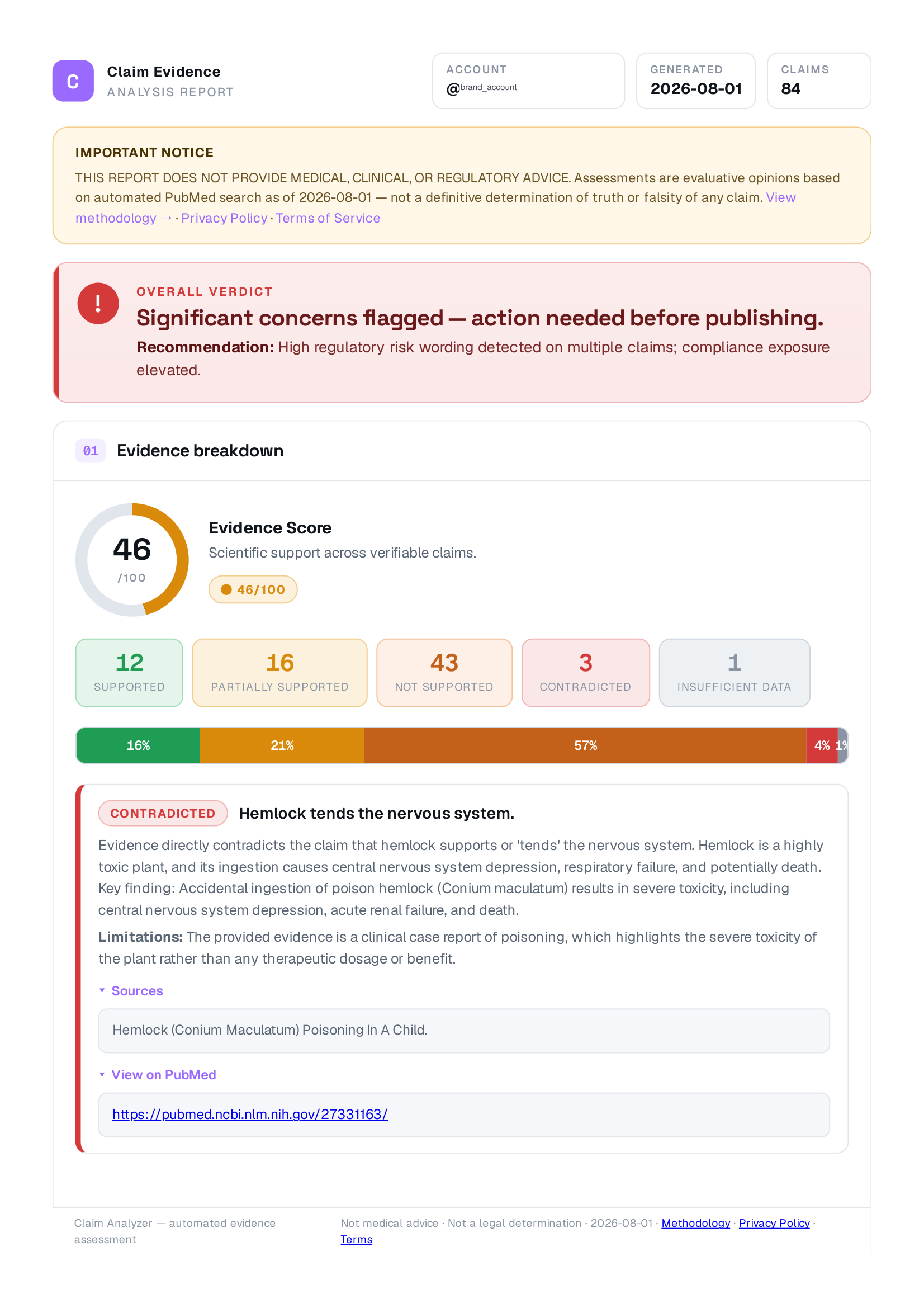
The verdict, up top
Every scan opens with a single call — publish, revise, or hold — and the evidence score across all verifiable claims. Leadership reads one line and knows where the account stands.

Influencer vetting · Beauty & supplement brands
ClaimScan scans a public Instagram account — a brand feed, a client, or a creator — extracts every product claim, cross-references each one against PubMed clinical evidence, and flags FTC/FDA regulatory risk. A compliance report in minutes, not weeks.
No signup. No automated emails. A human replies with a real report.
Regulators hold the brand responsible for what creators say — even when the creator wrote the caption. Recent enforcement:
FTC judgment over detox-tea health claims promoted by celebrity influencers; the order names the claims, not just the hashtags.
FTC judgment over height-growth supplement claims made without adequate scientific substantiation.
Under the FTC's 2024 Fake Reviews Rule (16 CFR 465), each violating post can count separately. First enforcement letters went out in December 2025.
Every case above is verified against the primary source (ftc.gov / federalregister.gov). We publish a breakdown of one enforcement case per week on LinkedIn.
One input: a public Instagram handle. No access, no passwords, no pixel.
We pull up to 100 recent posts from the public account — captions, and transcripts for reels.
Every explicit product claim is extracted and deduplicated. A typical brand feed carries 40–100 distinct claims.
Each claim is cross-referenced against PubMed clinical literature — supporting and contradicting citations attached.
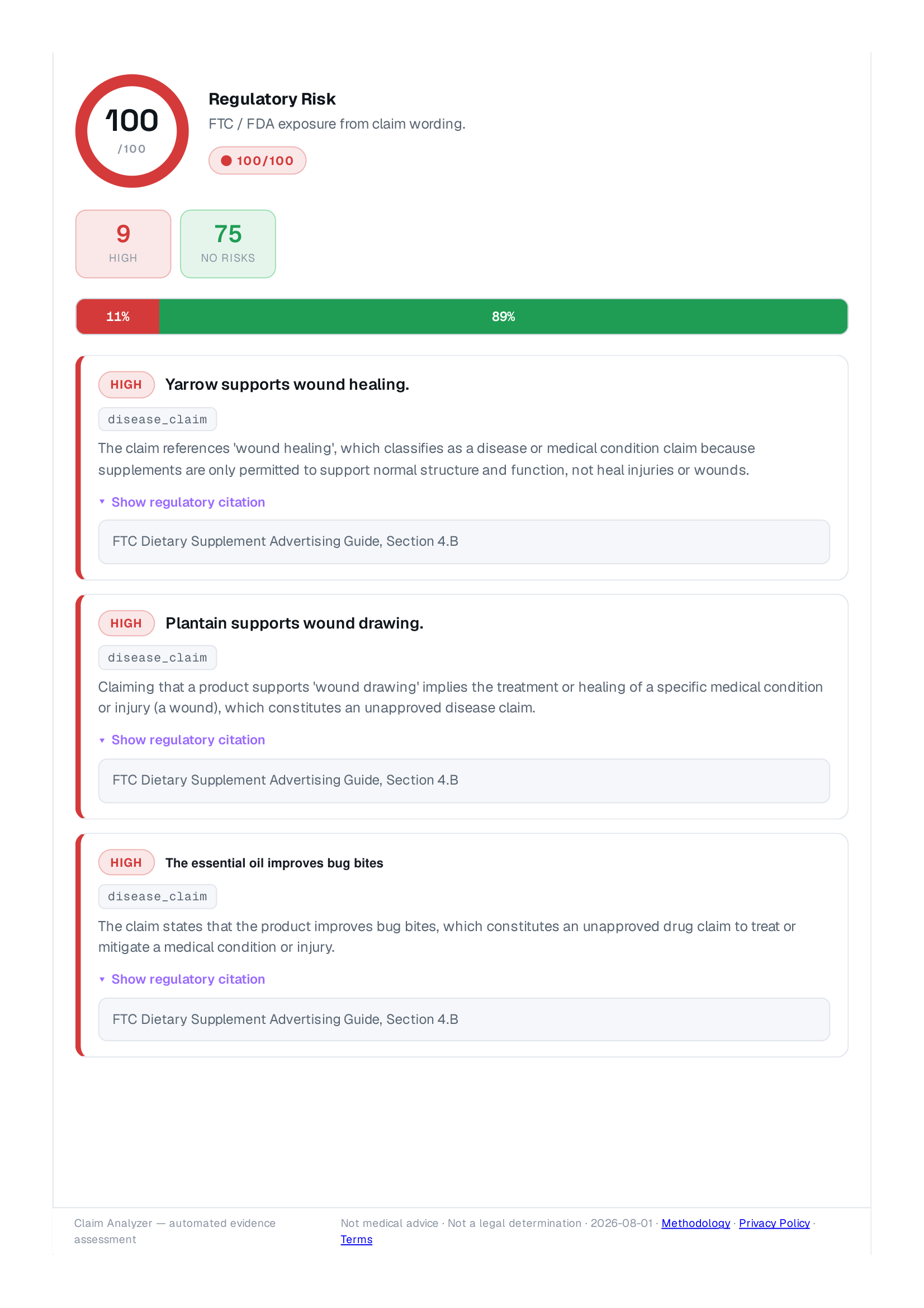
Each claim is classified against an FTC/FDA risk taxonomy and the report is ranked by risk, highest first.
The line that matters: FDA permits structure/function claims ("supports digestion") but not disease claims ("treats bloating"). Our taxonomy is built around that distinction — the one that triggers enforcement — and every risk call comes with the PubMed evidence next to it.
Excerpts from real scans of public supplement accounts (June 2026). Handles and product names removed.
Every scan opens with a single call — publish, revise, or hold — and the evidence score across all verifiable claims. Leadership reads one line and knows where the account stands.

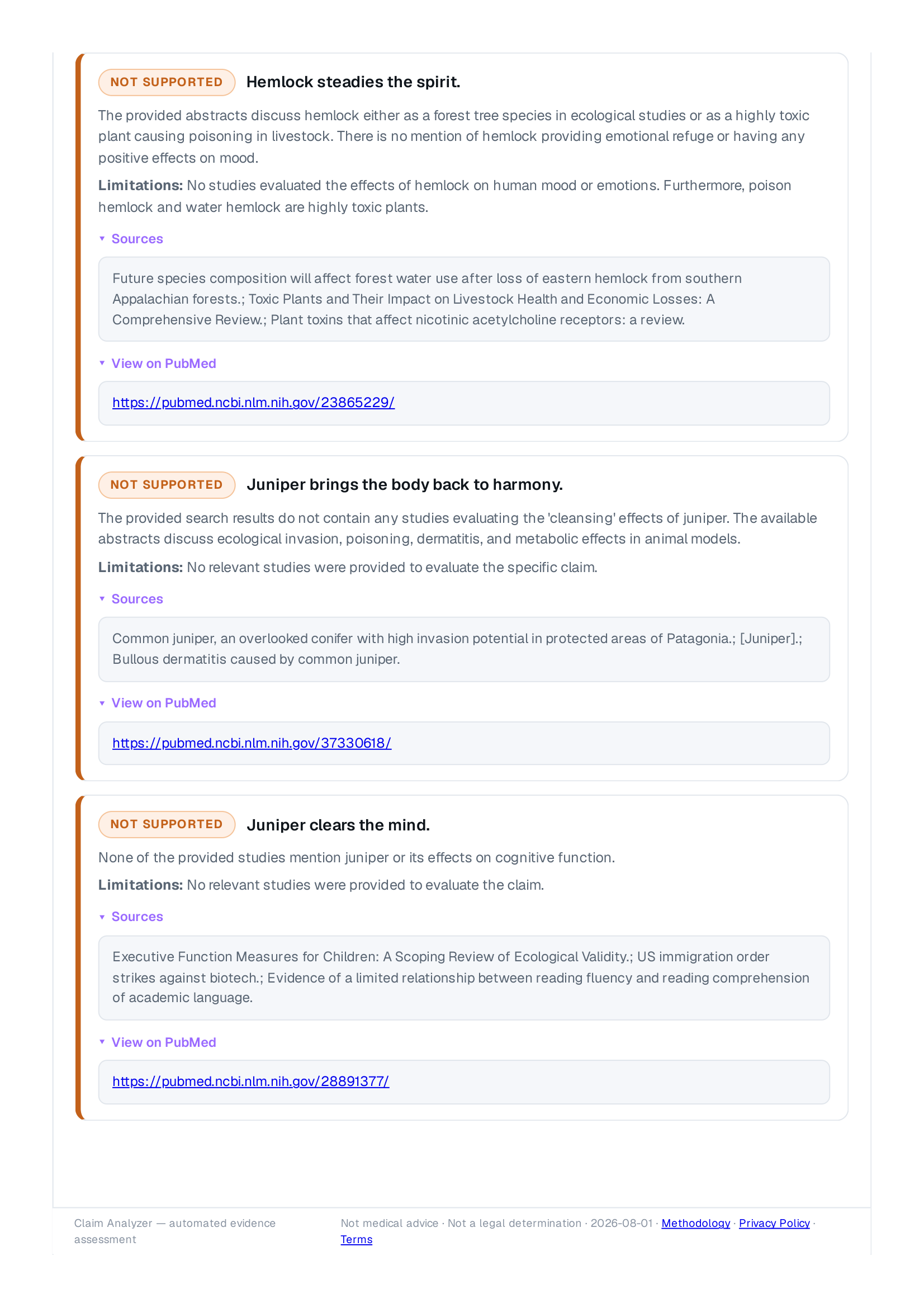
Supporting and contradicting studies are pulled from PubMed and attached to the individual claim, each with a direct citation link. No opaque scores — the source is right there.

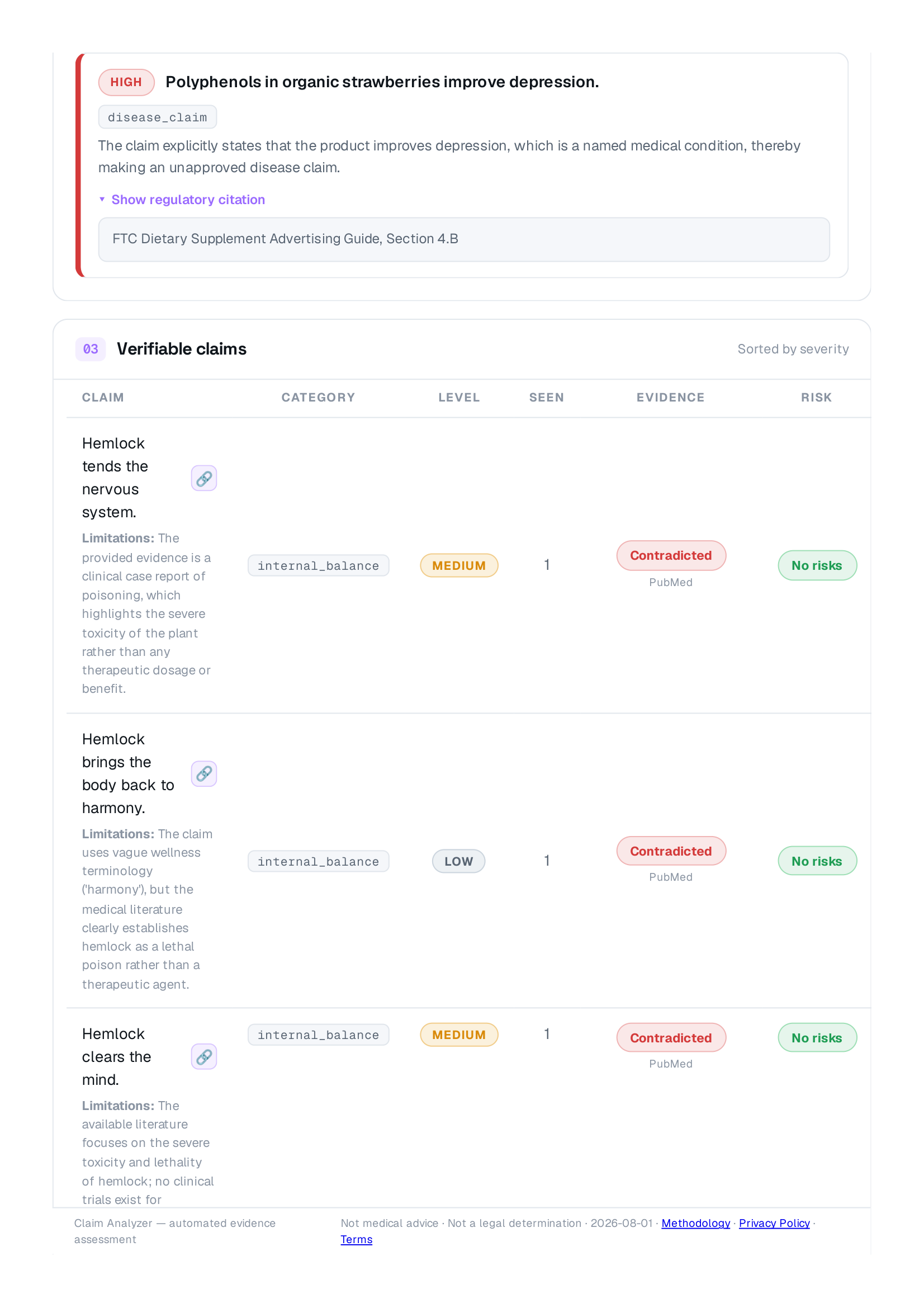
Each claim is scored against an FTC/FDA risk taxonomy — high-risk disease wording separated from compliant structure/function language — and the page ranks them worst-first.

The full table lists every extracted claim with its category, risk level, evidence status, and how often it appeared — the complete audit trail behind the scores.

Real pages from scans of public supplement accounts — account handle and product names removed. Scores and claim wording are unedited.